
Polimi and Enigma brought counterfeiting at another level
17 July 2026
What does it take to push the boundaries of document security? According to our team behind the Keeper Project, it takes chemistry, hardware engineering, software architecture, and the kind of cross-disciplinary collaboration that only happens when a world-class university and an agile startup work shoulder to shoulder towards a shared goal.
For the last few months, the Politecnico di Milano, and its spin-off company Enigma Srl have been working on one of the most comprehensive systems for counterfeit prevention: the integration of sophisticated spectrally coded ink, multi-surface printing technology, and software into a single industrial-scale authentication architecture.
At the heart of the system is a library of over ten proprietary inks, each engineered to carry a unique spectroscopic signature. These are not conventional security inks: each formulation is designed so that its chemical identity can be read, verified, and matched with a speed and precision that makes counterfeiting practically impossible. The inks have been validated across two distinct printing technologies — screen printing and continuous injection — ensuring compatibility with a wide range of industrial production workflows.
The range of substrates successfully tested is equally remarkable: polycarbonate cards both laminated and unlaminated, passports, cardstock, banknote paper, and electronic boards. This breadth of coverage means that Keeper can deliver Level 3 anti-counterfeiting protection across a product spectrum that was previously unreachable by any single solution.
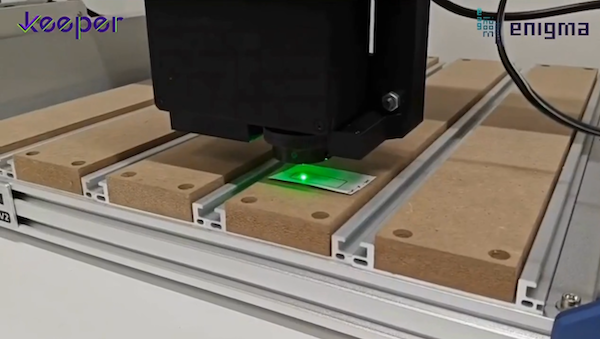
Closing the loop between chemistry and the end user required software, the first pillar is 3VERA, a state-of-the-art reading and verification platform built to the highest cybersecurity standards. Through full control of both the laser spectrometer and the translation stage, 3VERA delivers readings that are fast, accurate, and presented in a clean, user-friendly interface accessible to operators at every level of technical expertise.
A granular permission system ensures that each user interacts only with the functions and data relevant to their role, while the proprietary detection algorithm handles the complex work of ink and pattern recognition autonomously. All readings are logged and stored in a scalable archive — designed to handle thousands of consecutive entries — so that historical verification data is always available for audit, compliance, or investigation purposes. At 0.3 seconds per reading and with hundreds of successful verifications already completed, 3VERA sets a new performance benchmark for field-deployable authentication tools.
The second pillar is 3PRINT, the production-side twin of 3VERA. It gives operators complete control over the printing process: users can design custom security patterns, generate randomised batches, and execute print sequences — all from a single, intuitive interface. Every pattern printed is saved and linked to the ink composition used, creating a cryptographically traceable chain between manufacture and verification.
The entire system rests on a local database infrastructure, enabling rapid deployment with minimal external dependencies. Comprehensive logging systems support straightforward troubleshooting, and direct technical assistance is available from the team. The system was designed from day one with industrial scale-up in mind: whether running tens or thousands of verifications daily, the architecture holds.
Project Keeper does not merely offer a new security product. It redefines what Level 3 anti-counterfeiting can mean. Faster, broader, smarter, and more resilient than anything that came before it.