


When security is not just visible, but measurable
29 July 2026
Anti-counterfeiting is no longer relevant only for banknotes, identity documents or high-security credentials. More and more industries are facing the same challenge: products must be clearly identifiable, verifiable and traceable. This applies to ID documents as much as to branded products, spare parts, packaging and, in the future, digital product passports under new EU requirements.
This is exactly where Variuscard contributed to the European research project KEEPER. The project developed a new generation of security features based on special nano-engineered inks. These inks can be applied to a product or document as individual codes or patterns and later verified with a dedicated reading system. Put simply: the security feature is not only visually present, but physically measurable.
For us as a card manufacturer, this is especially interesting because the technology does not stop at theory. A security feature only becomes truly relevant when it works not only in the laboratory, but also reliably in industrial production. This is precisely where Variuscard’s role began.
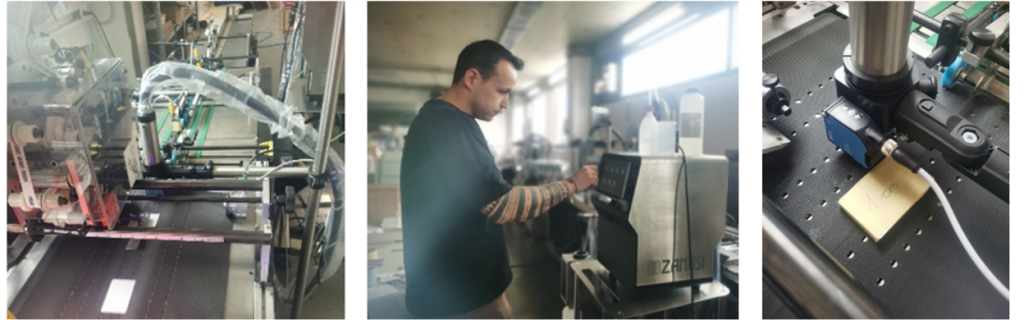
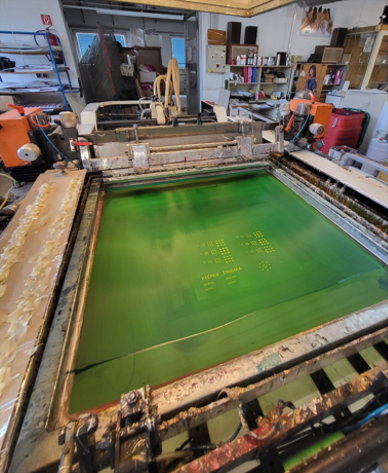
Our task within the KEEPER consortium was industrial validation. We tested how the developed security inks could be integrated into real production processes. This included testing different substrates, printing methods, card constructions and lamination processes. The main focus was on high-quality ID cards and security documents, where a feature should not simply be printed on the surface, but ideally be protected within the card structure itself.
Technically, this means that it is not enough to print an ink onto a material and confirm that it can be read. In card production, the security feature is exposed to heat, pressure, lamination, protective films, material layers and mechanical stress. At the same time, later verification must remain reliable. A code that is clearly measurable before lamination but delivers only a weak signal after the final card construction, has limited industrial value. These are exactly the questions we tested in practice.
A key part of our work was therefore to build the bridge between research and production. Which materials provide a stable signal? Which printing technology is suitable for variable, individual codes? How precise does registration need to be? How does the signal change after lamination? Which card construction protects the feature without making it unusable for verification? And how could such a process later be integrated into a real production line?
Not just ID documents
The approach is particularly relevant for ID documents. Security documents are traditionally built with multiple layers of protection: visible features, hidden features, machine-readable features and personalised information. The KEEPER technology could add another layer: a physically verifiable feature that is difficult to copy and can be validated with a dedicated reader only. This means that not only the appearance of a document is protected, but its authenticity can be technically verified.
At the same time, we looked beyond traditional card applications. The same principle could also become highly relevant for brand protection. Manufacturers around the world are fighting counterfeit products, grey-market distribution and manipulated supply chains. A hard-to-copy security feature integrated directly into a product or its packaging can provide an additional layer of protection. This becomes even more powerful in combination with digital product passports: the digital record describes the product, while a physical security feature on the product itself proves that this specific object belongs to that record.
This is an important distinction. A QR code can provide access to information, but it can also be copied. For many applications, simply linking a product to digital information will not be enough. There needs to be a trustworthy connection between the digital identity and the physical object. New security technologies such as those developed in the KEEPER project can play a decisive role here.
More than research
For Variuscard, participating in KEEPER was therefore more than just a research activity. It was a step towards the next generation of secure, verifiable and intelligent products. As an Austrian card manufacturer, we have been working for many years with printing, personalisation, RFID, smart cards and security features. In the KEEPER project, we contributed this industrial know-how to help transfer a new technology from the laboratory into real-world applications.
Innovation is not created by describing a promising security feature on a technical datasheet. Innovation happens when you run it through heat, pressure, production speed, material limitations and quality control, and it still works afterwards.
That was exactly our contribution to the KEEPER project: we tested, validated and translated research into industrial reality. For more secure ID documents. For better product protection. And for a future in which physical products and digital identities are reliably connected.