


Compressive Raman: low-cost, high-speed chemical imaging comes out of the lab
04 September 2026
How the KEEPER project shrank a cutting-edge Raman imaging system into a hand-portable device — without giving up sensitivity.
Raman spectroscopy: a fingerprint for every molecule — read very slowly
Raman spectroscopy is one of the most powerful analytical tools available: shine a laser on virtually any material and the light scattered back carries a spectral “fingerprint” of its chemical bonds. No labels, no sample preparation, no contact. This is why Raman is used everywhere from pharmaceutical quality control to art authentication.
Raman has one notorious weakness: it is slow. Spontaneous Raman scattering is an extremely inefficient process — typically only one photon in many millions is converted into useful signal. Reading a single spectrum can take seconds; building an image, where a spectrum must be acquired at every point, can take minutes to hours. For a rapid analysis at a border post or on a production line, that is simply not viable.
Coherent Raman imaging: fast, but at a price
The scientific community’s mainstream answer to slow Raman is coherent Raman scattering (techniques such as CARS and SRS). By driving molecular vibrations with synchronised ultrashort laser pulses, coherent Raman boosts the signal by orders of magnitude and delivers video-rate chemical imaging. It is a spectacular technology — and an expensive one. Coherent Raman microscopes are built around ultrafast pulsed laser systems and typically cost several hundred thousand euros, require expert operators, and remain firmly bolted to an optical table in a specialised laboratory. Fast Raman imaging has existed for two decades; affordable, handheld fast Raman imaging has not.
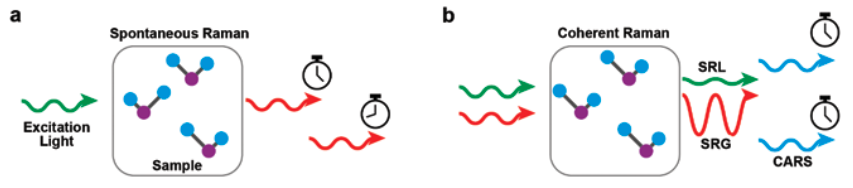
Figure 1 – Two types of Raman-based processes. In spontaneous Raman scattering (a), a laser beam impinged on the sample undergoes an inelastic scattering process to generate a new color. The difference between the two colors (in and out) provides the chemical information: the vibrational spectrum. In coherent Raman scattering (b), the molecular vibrations are driven by laser beams with well-defined timings (in opposition to the spontaneous case), which yield extremely strong signal levels and therefore faster imaging speeds.
Courtesy of Hilton B. de Aguiar.
Compressive Raman imaging: high speed at low cost
Compressive Raman takes a different route. Instead of making the light–matter interaction stronger with costly lasers, it makes the detection radically smarter. The core idea: for a given task you do not need to measure the full Raman spectrum at every pixel. A programmable micromirror array (DMD, the same chip found in consumer video projectors) selects, in hardware, only the spectral features that carry the relevant information, and funnels them onto a single-photon avalanche detector (SPAD) that counts photons with near-perfect efficiency. Rather than dispersing precious Raman photons across thousands of camera pixels, every photon that matters lands on one ultra-sensitive detector.
The result is a dramatic shortcut: classification and imaging speeds approaching those of coherent Raman (Gentner, Opt. Lett. 2024), obtained with a simple and cheap continuous-wave laser and components — not hundreds of thousands. Speed no longer comes from expensive photonics; it comes from measuring only what is needed followed by modern computational analysis.
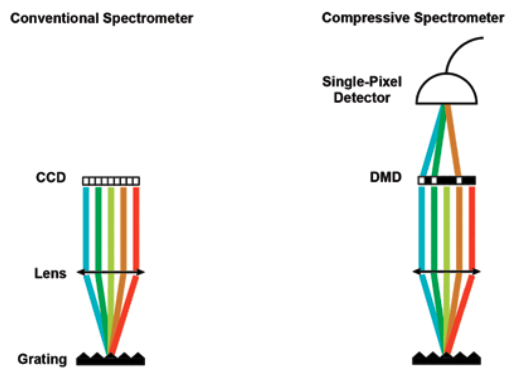
Figure 2 – A comparison between conventional and compressive spectrometers. In compressive spectrometers, the costly CCD camera is replaced by a DMD combined with a single-pixel detector. This scheme is considerably cheaper than the conventional one and may allow for faster imaging.
From an optical table to a 2 kg device: a 100× volume reduction
At the start of KEEPER, our compressive Raman imaging system occupied a 1 × 1.5 m optical table — roughly half a cubic metre of precision-aligned optics, within the reach of specialised users only. Through a few successive design iterations, the CNRS team compressed the complete optical train into a single opto-mechanical block with an optical footprint of just 125 × 300 mm, assembled into a hand-portable instrument of about 2-3 kg. In terms of occupied volume, that is a reduction of roughly two orders of magnitude — about 100× — turning a laboratory installation into a device that can be carried to the sample, rather than the other way around. There is still some work to do for a final version (include closure, batteries, and power supplies), but the device remains fully hand portable.
Just as important as the optics is the electronics. The timing-critical orchestration of DMD patterns, photon counting and beam scanning — tasks traditionally handled by racks of proprietary acquisition hardware — now runs on a compact embedded controller. No proprietary acquisition systems, no rack, no dedicated PC.
There is free-lunch: considerably cheaper than conventional Raman at high sensitivity
The second headline result is cost. A conventional research-grade Raman imaging microscope with comparable sensitivity is a 100k€-plus instrument — and coherent Raman systems cost far more. The complete optical and opto-electronic bill of materials of our prototype represents a considerable cost reduction compared to conventional high-sensitivity Raman instrumentation. This is the direct payoff of a deliberate off-the-shelf philosophy applied throughout the project. Crucially, sensitivity is not sacrificed: the photon-counting detection chain preserves the ability to work with the faint signals of spontaneous Raman scattering with high fidelity.
Democratising Raman imaging
The remaining steps to a market-ready device are engineering, not science. This transition is already underway: building on the technology developed and de-risked within KEEPER, the team has just launched Raiman, a startup dedicated to bringing compressive Raman imaging to market, currently raising its pre-seed round. By demonstrating that high-speed, high-sensitivity Raman imaging could be built for the price of a high-end laptop rather than the price of a house, compressive Raman opens the door for applications wherever rapid and non-invasive chemical identification is needed. A technique that has lived for almost a century in specialised laboratories is, at last, becoming a tool anyone can put on a desk — or in a backpack.
This work was carried out by the LKB/CNRS within Work Package 2 of the KEEPER project, funded by the European Union (EIC, project 101112988).